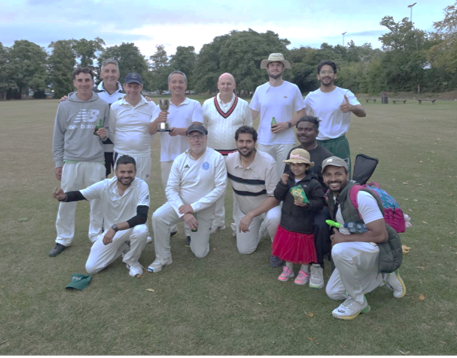
They Can't Kick Us Out Now
At some point during the day, we were informed that our gracious hosts had grown tired of the same jokes being trotted out every year and that the only way to secure an invitation back next season was to retain the cup.
To some, possibly only Director Mills, Handbags is Christmas. Like Christmas, it generally ends in tears. Nevertheless, a year without it would be unthinkable.
We arrived in the unprecedented position of having won our first game. Goldstein, captain victorious of years gone by, was once again handed the reins. Not, you understand, through any machinations of his own, but through the widespread misconception that he might be the best man for the job.
In what passes for a selection committee meeting, or WhatsApp as it is colloquially known, the Director observed:
"He marshalled a dispirited and injury-afflicted XI to a thumping bounce-back victory against Cavs last year."
Could he do it again? What could possibly go right?
Winning the toss, for one thing.
Traditionally, the final overs of the tournament are played in near darkness, where batsmen and fielders alike are required to track the ball largely by sound. Generations of captains had reached the same conclusion. Bat first and ask questions later.
Goldstein, very cunningly, was nowhere to be found at the time of the toss. Forget luck or statistical probability when it comes to coin tossing. If you want guaranteed success, involve an Australian. Preferably a Sydneysider.
Enter Tan, a keen practitioner of Toss the Boss and therefore uniquely qualified in matters involving coins, probabilities and alcohol. Unsurprisingly, Dalkey won the toss and elected to bat.
After a brief consultation with Reay, the captain immediately abandoned his carefully prepared batting order and sent Director Mills out to open alongside Tan.
Last year, Tan required only ten deliveries to secure retirement on twenty. This year he lasted six balls before being caught behind for four.
And so commenced the procession.
Bajpai made two before finding deep midwicket with the sort of precision normally reserved for military operations. Jazzy contributed five from eleven deliveries before advancing purposefully down the pitch and discovering that the ball had no intention of joining him.
Ramam's instructions were simple: take your time.
Dot.
FOUR.
At the non-striker's end this represented healthy intent. Among the waiting batsmen, it was interpreted rather differently. Pads were hastily fastened and helmets located as visions of another swift collapse came unbidden to mind.
Having successfully negotiated the difficult business of settling in, he began to compile a useful innings.
Meanwhile, Director Mills, having survived a barrage of high-quality fast bowling and watched wickets tumble steadily at the other end, suddenly changed gears. Having spent much of the innings in survival mode, he concluded matters with three consecutive boundaries. Retirement followed shortly afterwards, along with applause from those who had begun to doubt they would ever see him leave the crease.
His 22 from 27 deliveries represented his second retirement of the day and, remarkably, his third consecutive retirement in his last three Handbags matches.
Something, at least, had gone right.
Bennett's innings was fluent but achingly brief. He was run out for five.
Sasidharan announced himself by hooking the first ball he faced for a magnificent six, prompting enquiries from the opposition as to which IPL franchise we had acquired him from and what outrageous falsehoods had been employed to persuade him to sign. Such discussion subsided shortly thereafter when he was run out for 13.
Thomas looked comfortable for ten deliveries before chasing a ball so wide that concerns briefly arose for the wellbeing of the square-leg umpire. He was caught in the deep.
The ever-dependable Reay arrived at number nine with five overs remaining and promptly helped restore order. A productive partnership followed until Ramam, attempting to raise the scoring rate, was run out for 16.
With two deliveries remaining, Reay was stumped for 16.
At this point, umpires Gordon and Taylor evidently decided they had seen enough and closed the innings early, forcing the Dalkey captain to turn on his heel midway to the crease and depart under what can only be assumed were the Ferret Bylaws of 1802.
Dalkey had amassed 124.
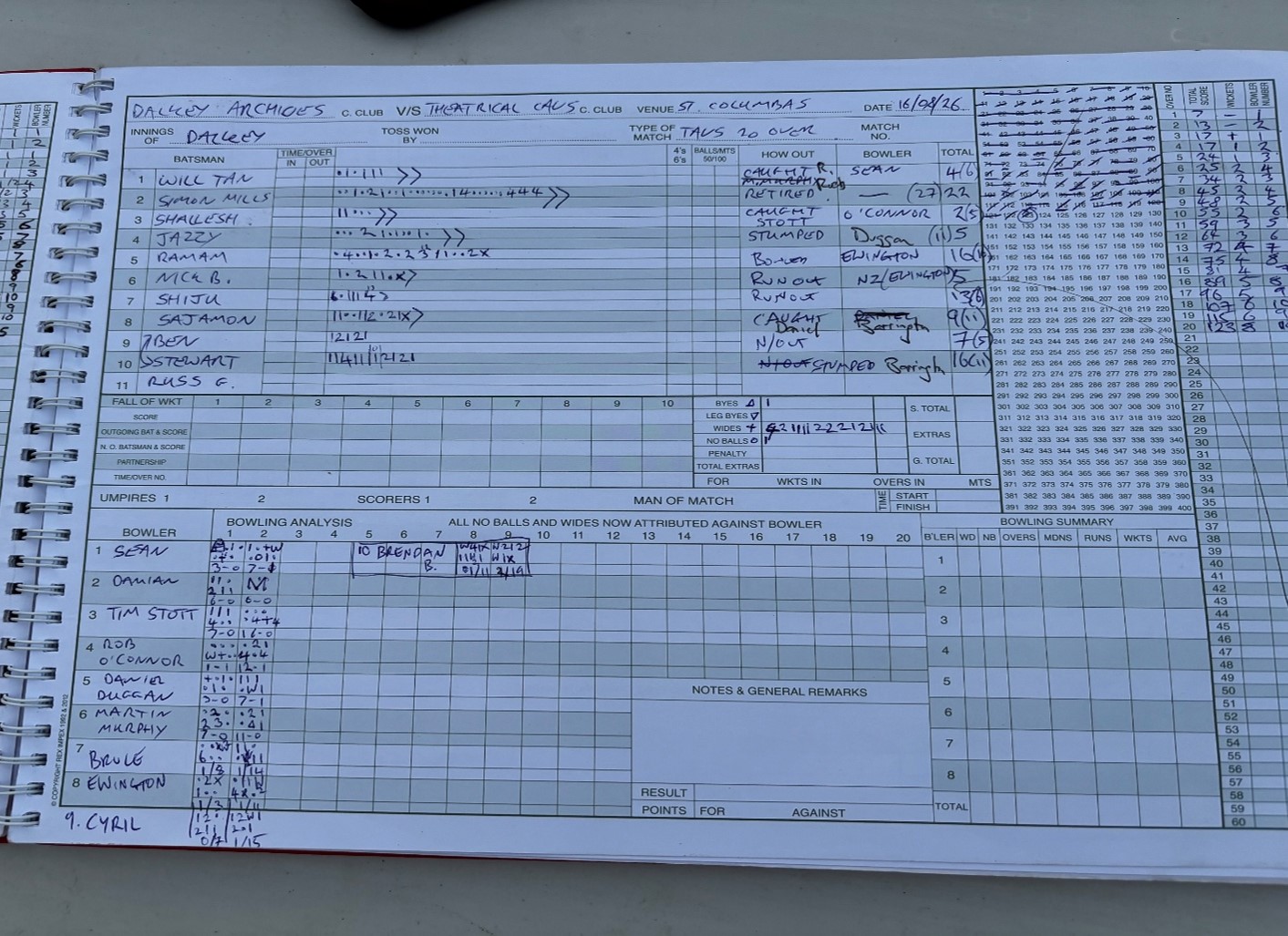
The Dalkey innings
The equation was simple. Beat the Cavs outright or prevent them reaching the target within 18.5 overs. Failure would mean the cancellation of cricketing Christmas.
During the interval, further expert advice was sought. The bowling plan survived almost twelve seconds.
Dalkey's scouts, Ramam and Thomas, had observed the Cavs batting and determined that what was required was an opening attack of outright pace. As every South African knows, when confronted with uncertainty there are only two sensible responses: call for a scrum or bowl faster.
And so, we began.
Sasidharan's first ball was frankly obscene. It struck middle stump at such speed that the bails appeared genuinely surprised by the whole affair.
Alas, the first ball being free, the wicket existed only in a moral sense.
What followed was an excellent spell of fast bowling from Sasidharan, Ramam and Bajpai, one in which the opposition openers became increasingly comfortable facing as the innings progressed.
Enter Bennett.
Well-known on the circuit and, most importantly, nowhere near as quick.
The batsmen's eyes lit up. Around the field, several men suddenly found themselves wondering whether their health insurance covered impact injuries.
Fielders directed questioning looks towards the captain. Had he finally blinked? Was this merely an elaborate scheme to purchase a collection of retirements?
Emphatically not.
Deveney played around Bennett's first delivery to the sweet sound of leather striking timber.
Another thing had gone right.
The remainder of the over was less successful. Ellington helped himself to a four and a six before promptly retiring.
With the dangerous opening pair removed, Dalkey bent to their work and the slow strangulation began. Stott was run out despite the best efforts of the fielding side to pinball the ball around the square before it eventually found its way into the keeper's gloves.
Director Mills, having earlier delivered a parsimonious over which included a valiant attempt at a caught-and-bowled, was thrown the ball once more.
"Enjoy yourself," said the captain.
"I never enjoy bowling," came the reply.
Evidence to the contrary arrived almost immediately.
Mills clean bowled Meehan.
Another thing had gone right.
Not to be outdone, Sweeney O’Brien removed Murphy courtesy of a catch from Thomas.
Stott, having quietly accumulated 19, was stumped by Ramam off the bowling of Reay in pursuit of glory before enforced retirement could intervene.
By the time Barrington was run out following the combined efforts of Goldstein and Thomas, resistance had largely become theoretical.
And so, in the fading light, cricketing Christmas was saved for another year.
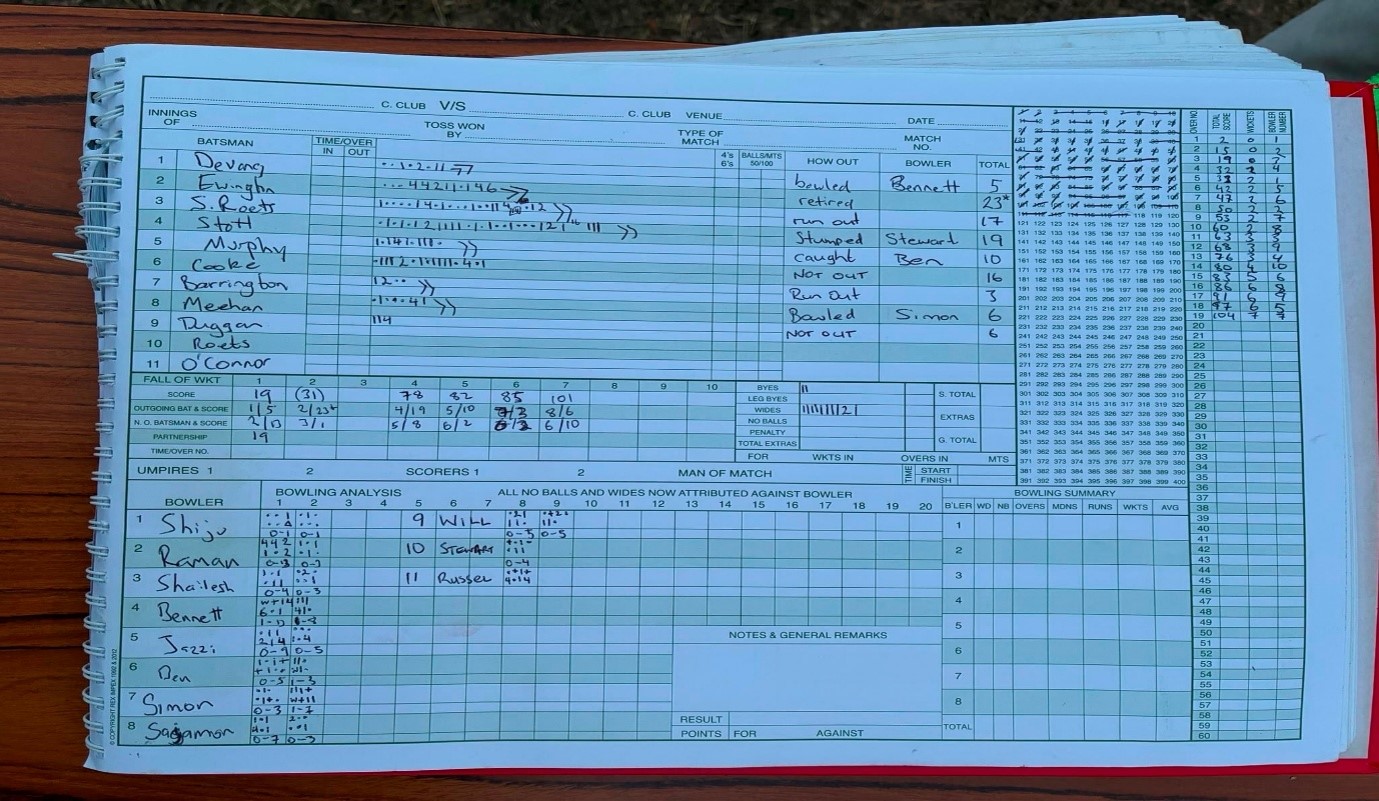
The Cavs innings
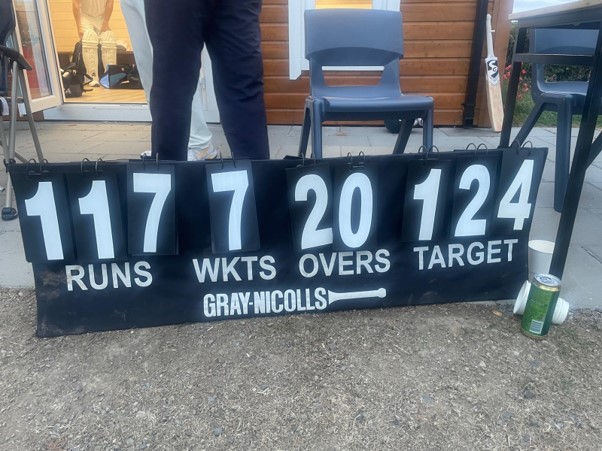
The final scoreboard
The cup remained in Dalkey hands. Most importantly, a return invitation had been secured. We think.
As it turned out, quite a lot had gone right.
Surely they can't kick us out now?
[Written by Russel Goldstein]