

Dalkey arrived at an overcast Shanganagh Park shorn of its multinational stars who had contributed so much to its retention of the prestigious Handbags Trophy just five days before. Gone were Werner, Tan, Ramam, Shiju and Jazzy. Modesty would preclude him from ranking himself among such Galacticos, but also missing was Director of Cricket Mills, currently in a rich vein of form with two retirements at the Handbags.
With the only foreign flair provided by Sajomon, Shailesh and Goldstein, the Archivists would have to depend on its Anglo-Irish talent (?) to stand any chance of beating the resurgent Terenure Walnuts. And the wiliness and motivational skills of Captain Lewis. Who took one look at the assembled troops and promptly delegated his on-field captaincy duties to Bennett, keeping only the post-match speech-giving ones for himself.
With access to the forest on one side of the ground still blocked by temporary galvanised steel mesh barrier fencing erected for the construction of a cycling path, both captains agreed to bowl all overs from only one end to facilitate ball retrieval on the shorter offside. It was also agreed that each team would bowl 15 8-ball overs to counteract the fast-fading late-summer light.
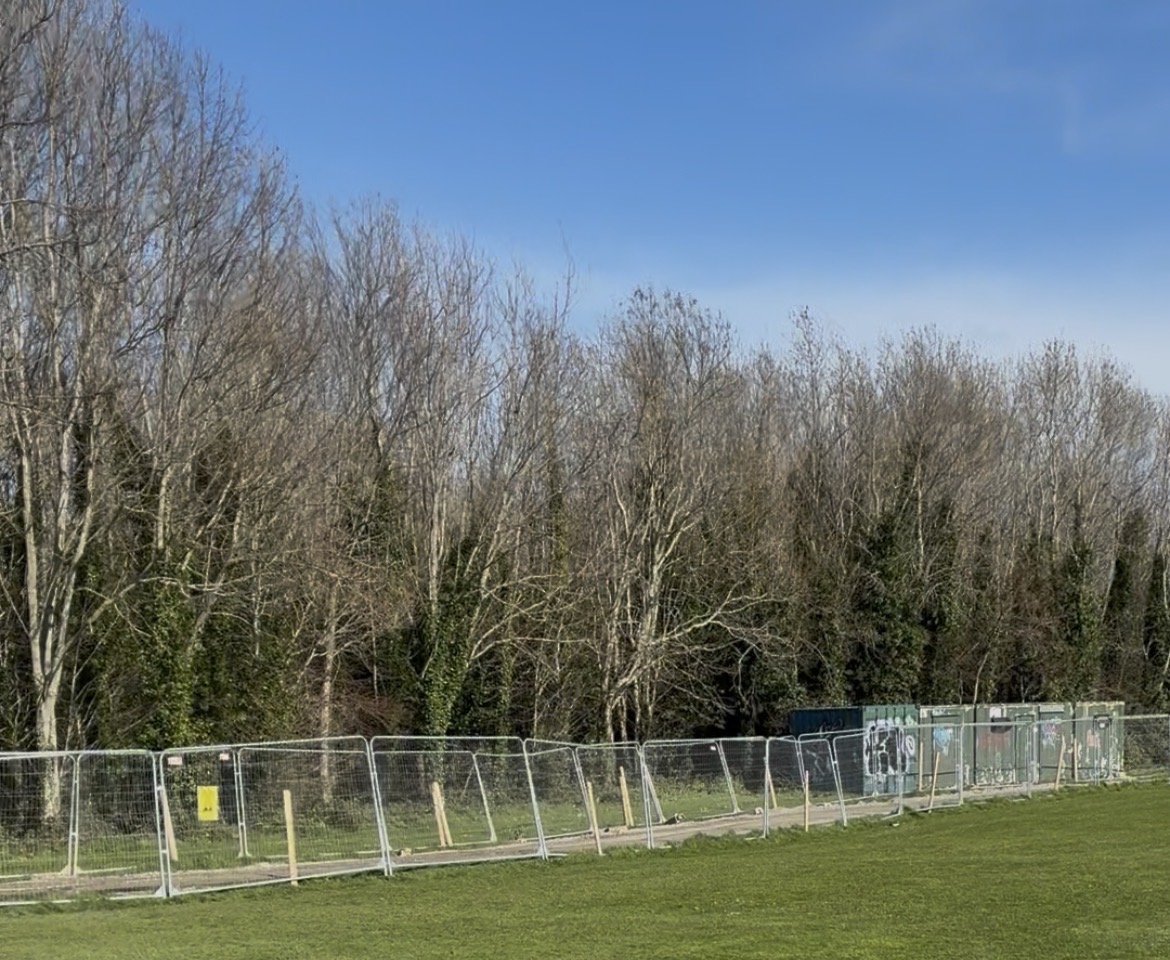
The encroaching Heras-style fencing on the offside
Bennett and Fanning opened the innings against the naggingly accurate Darryl. Fanning survived four dot balls before playing round a straight one to give the opening bowler a well-deserved wicket. The deployment of three speedy sure-handed fielders on the legside deprived Bennett and Tratalos of several easy boundaries, but the two Englishmen nonetheless succeeded in taking the score from 1-1 to 26-1 in the sixth over before the former played on for a largely untroubled 11. When Tratalos followed his compatriot back to the virtual pavilion a few balls later in the same over for a comfortable 17, it was left to new batsmen Sajomon and Goldstein to keep the momentum going.
But when both batsmen departed in the following over, Dalkey had lost four wickets in two overs and was beginning to look as collapsible as Bennett’s fishing chair.

Bennett's fishing chair
Fortunately, the wise heads of Smail and Hill came to the rescue. After hitting his third ball for 4, the man from Brighton went on to hit two more boundaries on his way to a pugnacious 12-ball 19 before, like Fanning, being bowled by the returning Darryl. At the other end, Hill started circumspectly, with a string of dot balls interspersed with singles. His innings was reading like a line of binary code, as if he were trying to compile an innings rather than build one. However, his painstaking compilation culminated in a pair of firmly struck off drives to the boundary that took him to a well-paced retirement.
The good work was continued by Shailesh and Reay coming in at nos. 9 and 10. The wagging tail has been a feature of recent Dalkey innings, often led by the horticulturist. Ably assisted by Shailesh who scored a quick 15 with two boundaries before being bowled by the tidy Anket, Reay took the attack to the bowlers with a fine array of cuts and drives. Although Sweeney O'Brien sacrificed his wicket in the late chase for runs, Reay punished wicket-keeper Gould’s loose bowling in a catastrophic last over costing 17 runs that featured three boundaries and two wides. Reay finished unbeaten on 18 and Captain Lewis brought up the rear with an unflustered 1 not out.
From the perilous position of 36-5 in the sixth over, the lower order had dragged Dalkey back to the respectable, but by no means imposing, total of 124.
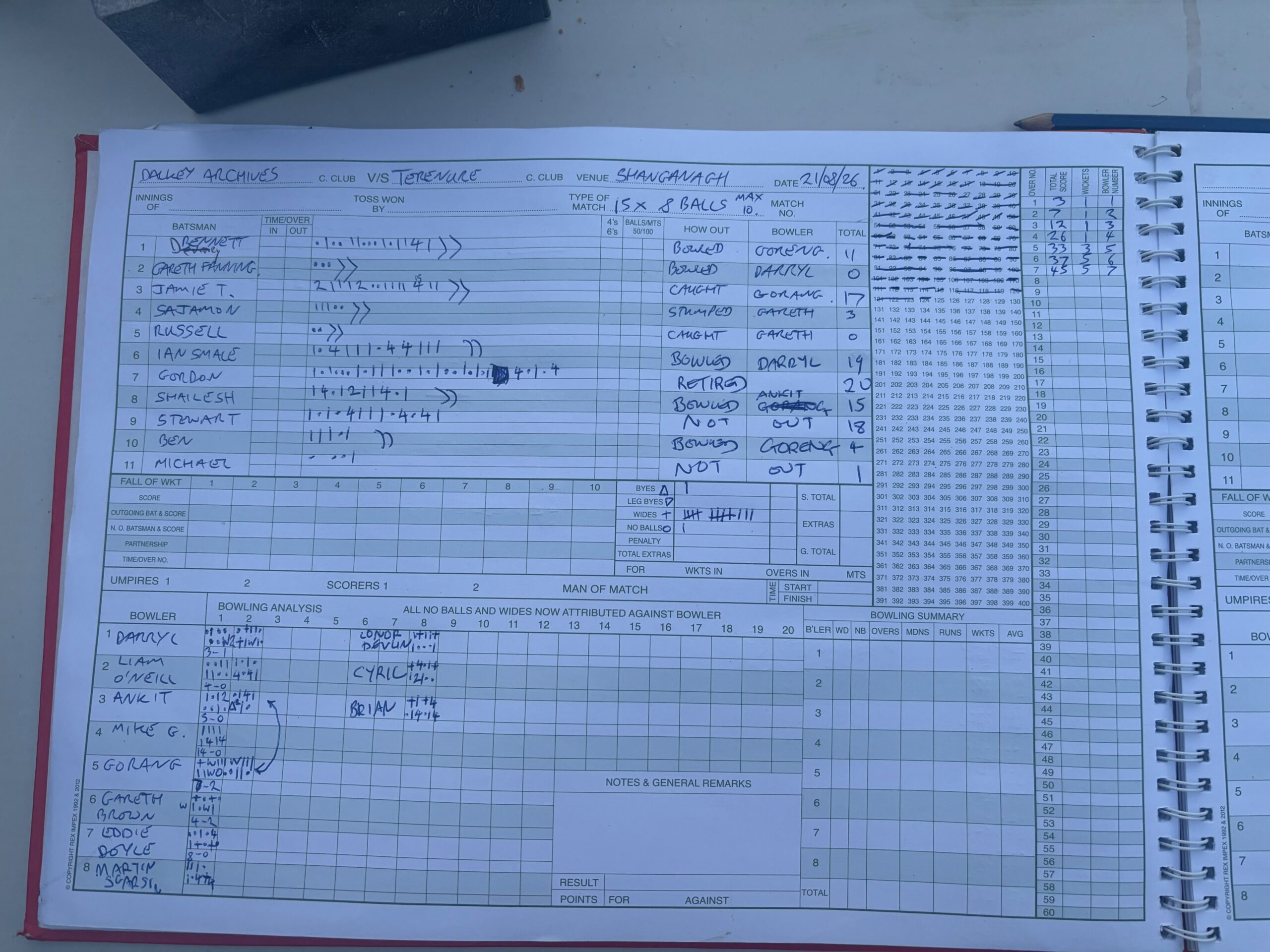
The Dalkey innings
Two tight opening overs by Reay and Shailesh that conceded only 6 runs generated enough scoreboard pressure to tempt Gourang into underestimating Captain Lewis’s unflappability at short midwicket. A calm pickup and quick throw to Saj at the bowler’s end punished Gourang’s fleeting fantasy of a quick single.
The Walnuts finished the third over at 13-1, with incoming batsman Daryl looking ominous. The danger was confirmed by a flurry of runs off Goldstein’s next over that accelerated them to 24-1 off four overs.
The assault continued in the next over as Daryl carved Sweeney O'Brien high over point for what looked like a clear six. But who was the fleet-footed fielder racing back to the boundary in pursuit of the falling ball? And how could he possibly catch the ball without himself crossing the rope? If the nearby Bennett had been a well-trained professional cricketer, he would already be running towards the boundary in anticipation of an acrobatic mid-air flick back to him by Shailesh. But the quick-thinking Shailesh had already scanned the situation and knew that no such help would be at hand. Instead, he somehow managed to take a superb running catch and put on the breaks all in the same movement. For one terrible moment, it looked as if he might slowly topple over the boundary, but he somehow regained his balance to complete an astonishing catch.
Captain Lewis then bowled an economic over that restricted Anket to only three runs from the first five balls. Browne was so bamboozled by the tantalising flight of the next two balls that he foolishly danced down the wicket to the last ball of the over to leave Tratalos with the simplest of stumpings.
Terenure was now on 34 after 6 overs, requiring another 91 off 9 overs.
Realizing the urgency of the situation, Grainger and Anket took 29 runs off the next three overs from Fanning, Smail and Hill. But even that was well below the required run rate.
With Bennett conceding just four runs off his own over, Terenure stood at 68 off 10 overs. They needed 57 runs off 5 overs. Having given an over to all 10 of his outfield players, Bennett now also had the luxury of leaving the last 5 overs to his strongest bowlers. This looked like a plan coming together.
But Terenure had other ideas.
Grainger and Anket plundered 11 runs off the 11th over from Smail. Although still a fraction under the RRR, they were now in the mood for the chase.
I don’t know what prompted Bennett to think he was one of the strongest Dalkey bowlers. Indeed, after his first five balls had only yielded four runs, he may even have been convinced of the wisdom of his selfish decision. However, hubris comes in many forms and the Englishman’s complacency was shattered by two enormous consecutive 6’s over extra cover by Anket for a max of 25. A last ball dot did little to restore Bennett’s dignity.
Terenure was now on 98, with only 27 required from three 8-ball overs. The RRR had fallen well below 10 and the momentum swing was palpable.
Shailesh responded magnificently with a pacy over that conceded only five runs.
Sajomon was even more miserly, yielding only two singles. When Grainger was run out off the penultimate ball going for a second run, it looked all over.
Dalkey had been saved by two excellent overs of really accurate pace bowling, delivered under the utmost pressure.
With Terenure now needing an improbably 18 off the final over from death bowler extraordinaire Reay, Dalkey minds drifted towards the post-match Pimms and weekend plans. Terenure’s no. 7 Devlin had unconvincingly scratched his way to six off nine balls and new batsman Gould was yet to face a ball.
Boom! Reay’s first ball was deposited into the offside forest by Gould.
This was not part of the plan.
Reay responded with two exocets outside the off stump that completely eluded Gould’s swinging bat.
12 runs were now needed off 5 balls.
Reay notched up the temperature with a scorching bouncer that flew over Gould’s evasive duck. Cries of disapproval rose from beyond the boundary. No ball called by the umpire.
So now 11 runs were needed off 5 balls …
Dot ball.
11 needed off 4.
The fearless Gould connected well with the next three balls, but good Dalkey fielding restricted him to only two runs off each ball.
Five needed off the last ball. The Dalkey fielders retreated to the boundary. Surely Dalkey was assured of victory now?
But no, Gould confidently smashed the last ball through a midwicket gap for a score-levelling boundary!
Another tie!! And probably the least engineered tie in Dalkey’s illustrious history of tie-making.
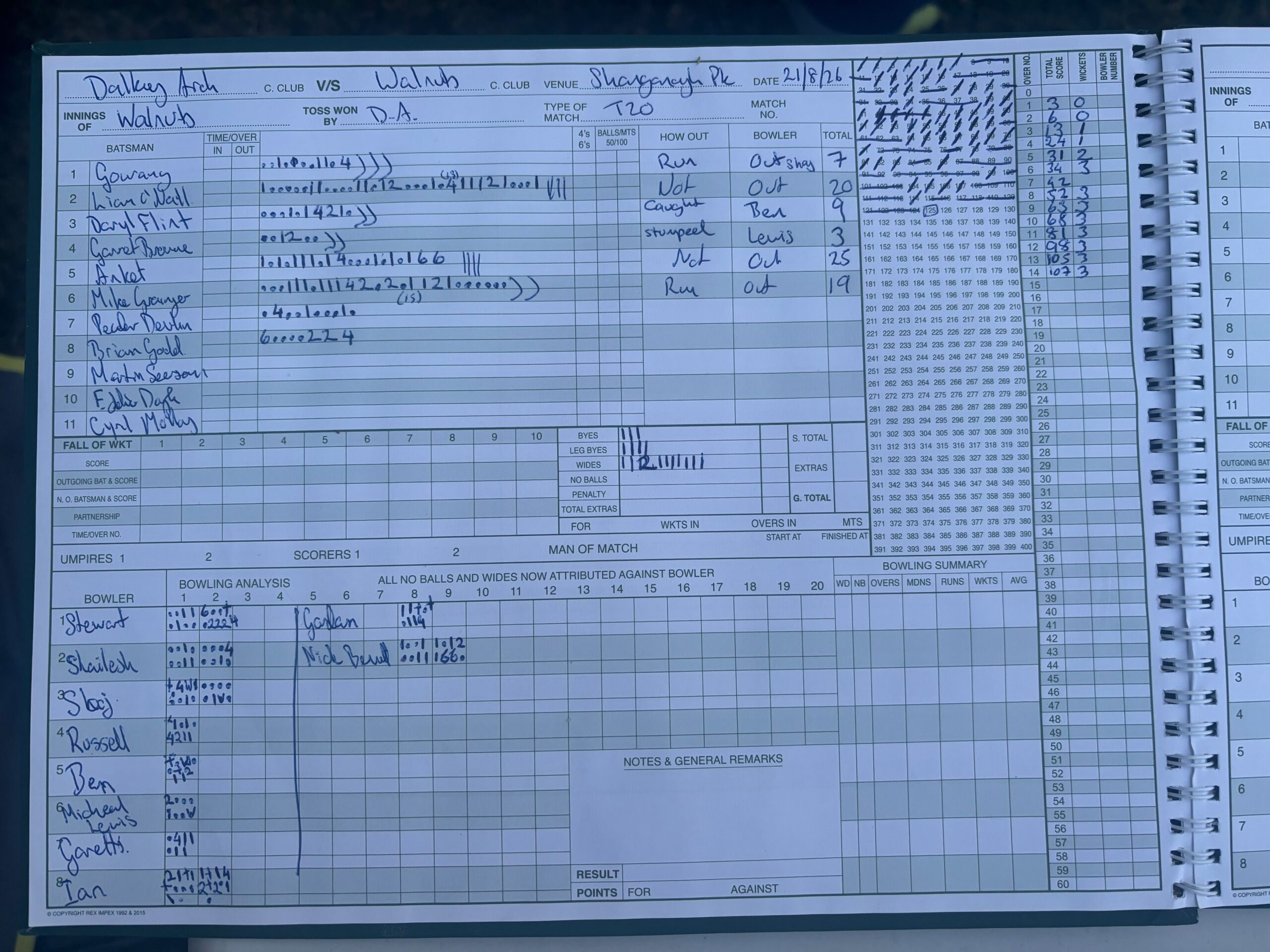
The Terenure innings
The Walnuts were ecstatic, while the Archivists were nonplussed and just relieved that Reay’s last delivery wasn’t a no ball.
At this stage, Bennett thought that he could finally relinquish his captaincy duties, but Captain Lewis then entrusted him with the selection of the Walnuts man of the match along with the creation of the bones of a speech. Although Gould seemed the obvious choice because of his final over heroics, Bennett, still stinging from his brutal assault, recommended Anket as the man who had done the most to swing the match back in Terenure’s favour. Whereas Anket had also taken a wicket in two tidy economical overs, Gould’s miraculous cameo of 16 runs in the one over was still overshadowed by the 17 runs he had conceded in his disastrous over at the end of the Dalkey innings. Oddly enough, both teams had been hit for 17 runs in their last over.
Shailesh was awarded the man of the match for his fine all-round performance and worldie of a catch. In the absence of a bottle of wine and the already departed recipient, a natty Walnuts cap was presented to Fanning who accepted it on Shailesh’s behalf.
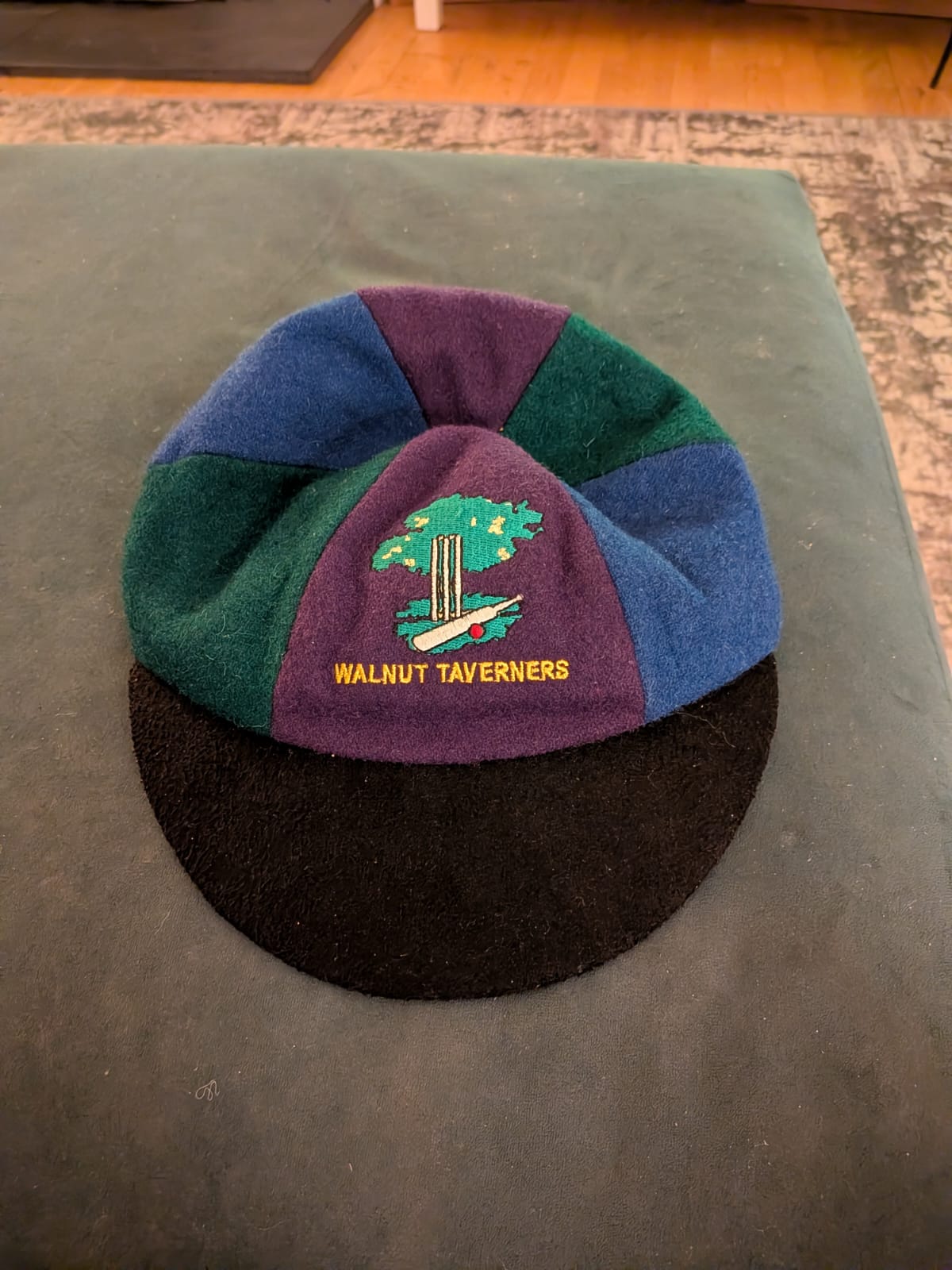
Shailesh's MOTM cap
All in all, it had been a highly enjoyable and competitive game between two well-matched teams.
As Bennett drove away from Shankill that evening, he permitted himself the comforting fiction that his captaincy was, at last, complete. But by morning his ego had got the better of him again, as he impulsively volunteered to write the match report himself. Captain Lewis, who moves in circles too elevated for such clerical drudgery, accepted with the swiftness of a man dodging a bullet. And so Bennett hopes that these last few words to the reader here will finally free him of all obligations to Captain Lewis. Description thus resolves into discharge.
[Written by Nick Bennett]